Glass Class 101: Bead Poop

Bead Poop 

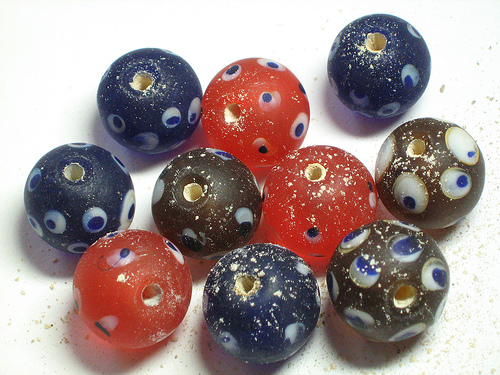
 Photo:  Mass market, lampwork beads –  lightly dry-reamed
BEAD POOP: Definition: (1) the crumbly, dirty remnants of bead release left in a lampwork bead’s hole once it has cooled and the mandrel removed; (2) the powdery crap you’ve learned to clean out of mass market lampwork beads so it doesn’t leave a mess all over your design; (3) the chunks of clay inside your bead holes that you eventually learn should be reamed under water so you don’t inhale all that dust.

Bead poop.  Yup, that’s what you’re seeing.  Now if you’ve ever bought mass market, lampwork beads like these, then you know exactly what bead poop is and how much of a pain it is to remove.  The beads above are from my old glass bead collection, purchased about 12 years ago (long before i ever knew anything about artisan lampwork) and at the time, very popular with my customers. 

Until I discovered artist-made lampwork, I accepted these glass beads as among the best I could find, bead poop as a normal part of bead buying and had an assortment of reamers to clean it out on my own.

So why is bead poop the topic of the day?
Because it’s a such simple thing yet one of the key differences between beads made by individual lampwork artists and factory-made, mass market lampwork beads.  Yes, both are made of glass.  Sure, both are made by hand.  And of course, both came off the torch with their holes filled to the gills with chunks of powdery bead poop.

Well, what’s the difference?
Lampwork artists clean out their bead poop.  Reaming bead holes is a sucky job (even for us) so we don’t make you do it.

And we won’t use just any bead release.  We worry about it.  We discuss it.  We even argue about it.  We hound bead release makers about improving their product and expect them to follow up.  We constantly experiment with multiple bead release formulas and various types of diamond reamers to figure out the clearest path to a completely poop-free bead.

You may not know this but lampwork nirvana is a transparent bead with a completely clear (not frosted) hole.  It means we’ve found that perfect combination of a bead release strong enough to securely hold the bead on the mandrel while we’re making it yet smooth enough to leave a completely clear hole.  And it means that one of the many reamers we’ve tried has just the right grade of fine diamond grit to clean out every last scrap of bead poop without also scratching up the inside of the glass.

But why such effort?
Because we care.  Every sale is an affirmation that one more person out there has become informed enough to appreciate what each of us has worked so hard to create.  Because we know you could have bought any of the gazillions of inexpensive, mass market glass beads out there but instead you bought ours.

Each and every purchase makes it all worth it: the hundreds (or thousands) spent setting up and stocking our studios; the many hours bent over the torch mastering each lampwork technique and exploring the possibilities of each rod of glass; not to mention the time spent ducking exploding glass, nursing burns and blisters, calculating ventilation, oxygen and fuel requirements, and researching the latest developments in hot glass, equipment or a new source of design inspiration.

Get it?
When you buy artisan lampwork, you’re not just buying a poop-free bead.  What you have in your hand is the accumulated effort of everything that one lampwork artist has struggled to achieve since they first sat behind a torch.

And that my dear readers, is the significance of bead poop.

Students, take your seats, please…

The first installment of GlassClass 101 starts this saturday!

Tales from the torch: Nov. 13/07

Custom orders sample 

This bead is a first try at a custom order.  It’s HUGE – approx. 2.5″ – I like it but the colours aren’t working for me.  I used three different shades of red frit for some colour gradations in the leaves and they all came out looking exactly the same.  WAY annoying.

Sample beads 

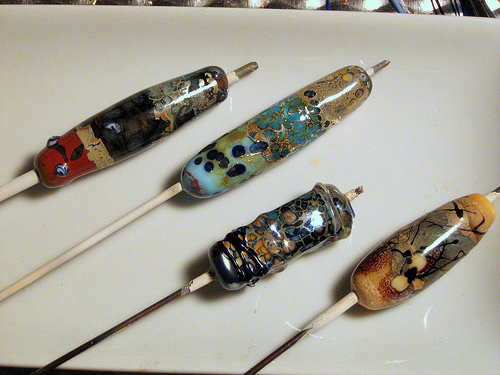
These are my test beads from last week.  They may not remain tests for long though, as their remakes were NOT an improvement. dammit.

On the good side that bead on the far right is my first bead to ever come out exactly the way i wanted (better even!) – i love it and it’s MINE. 

Aaah well, back to the torch!

Random thoughts

100_2690.jpg

Photo:  The Teenager enjoying a boat cruise at a luxury resort (c. 2004)

1. Child-free days off:  Gotta love ’em.  I’m off work today but The Teenager had to go to school.  Significance? I am totally and completely free! I can guiltlessly do whatever i want for the next 8+ hours!!! Plus! no demands, whining, backtalk or moodiness will interfere with my good mood until approx. 430pm today.  Could a dedicated mommy ask for more? 

 2. I often think in glass rod colours: Doesn’t matter where I am, if anything (usually some passerby’s colourful outfit) catches my eye, i’ll start to calculate how i can recreate that design and which colour rods i should use: oooooo… that lovely abstract blouse? Hmmm…i think a clear base, with a Moretti white and Lauscha blue latticino and an assortment of Gaffer pastel frits, perhaps as a focal, in a barrel shape – or should i use a press…?

3. Bad piercings:  On friday’s bus ride home, there was a young woman standing directly in front of me with a lip piercing.  Now normally i don’t have an issue with piercings (some are quite attractive) but this one just looked painful.  It was in the corner of her bottom lip, with the metal weaving three times in and out through her skin.  I kept trying not to stare but really?  i wanted to lean over and ask her:  “Sweetie, would you like me to help you take that out?” 

4. Karaoke madness:  Saturday night I found myself in a cheesy piano bar with some friends enthusiastically belting out Barry Manilow’s Copacabana to a room full of dancing strangers.  Once the adrenalin wore off it occurred to me that a piano player, a mike, a binder full of lyrics and a cheering audience can delude you into thinking (just for  a moment) that you can actually sing.

A moment of silence, please…

…for Canada’s veterans as well as those from all over the world. 

And a very special moment of silence to honour the memory of Canada’s many Black veterans who fought to keep our country safe despite seemingly insurmountable odds.

 black-ww2-veterans.jpg

Photo credit: Canadian World War II veterans, May 31, 1946, Photographer: John Boyd,  City of Toronto Archives
 American Revolution 1775-1783

Canada developed a reputation as a safe haven for Blacks during the American Revolution.  The British promised land, freedom and rights in exchange for services rendered and British Commander-in-Chief Sir Guy Carleton guaranteed that all slaves who formally requested British protection would be freed.  Some of the Black Loyalists to reach Nova Scotia belonged to the “Company of Negroes”, who left Boston with British troops.

General Henry Clinton formed a corps of free Blacks, called the Black Pioneers to clear and construct the town of Shelburne and settle the Black Loyalists in Birchtown, Novia Scotia.  An estimated 100,000 Blacks fled to the British side during the American Revolution.  Ten per cent of the Loyalists coming into the Maritimes were Black.

Maroons of Jamaica 1796 

On 22 July 1796, a group of 600 freedom-fighters landed at Halifax.  These immigrants, called Maroons, came from the Jamaican community of escaped-slaves, who had guarded their freedom for more than a century and fought off countless attempts to re-enslave them.

War of 1812 (1812-1815)
The Cochrane Proclamation invited refugees to become British citizens through residence in British territory, including Canada.  The British promise of freedom and land united many escaped slaves and free Blacks under the British flag.  Fearing American conquest (and the return to slavery), many Blacks in Upper Canada served heroically in coloured and mixed race regiments.

In the summer of 1812, Black Loyalist Richard Pierpoint petitioned the government of Upper Canada to raise a company of Black troops to help protect the Niagara frontier.  After some debate, the government agreed and a company of Blacks was formed under the command of a White officer, Captain Robert Runchey Sr. 

In 1794, based on their military service in the war, 19 free Blacks in the Niagara area petitioned Governor Simcoe for a grant of land to establish an all-Black settlement.  The petition was initially rejected, however, in 1815, Lieutenant-Governor Peregrine Maitland of Upper Canada began to offer Black veterans of the War of 1812 grants of land in the Township of Oro near Barrie, Ontario.  In 1819 the government officially established the Oro Settlement for black veterans.

Mackenzie Rebellion 1837
In the early 19th century, few Upper Canada militia units included Blacks.  When the Mackenzie Rebellion broke out, the government welcomed Black men into the provincial forces.  On 11 December 1837, a militia order authorized Captains Thomas Runchey and James Sears to raise a “corps of Negroes”.  Four days later, approximately 50 Blacks had joined the corps.

Royal Navy’s Seaman William Hall (b. 1827- d.1904)

In 1857, William Hall of Nova Scotia became the first Canadian Sailor and the first person of African descent to receive the Victoria Cross for bravery and distinguished service. 

World War I (1914-1918 )
During the First World War, Black Canadians joined combat units, despite significant racial opposition.   In 1916, as Canadian enlistment figures fell from 30,000 to 6,000 per month, while the year-end goal was a force of 500,000, Reverend C.W. Washington of Edmonton offered to raise an all-Black battalion.  Military officials authorized the creation of a segregated unit called the Nova Scotia Number 2 Construction Battalion which served in France with the Canadian Forestry Corps. 

Black Canadians at home became actively involved in the war effort.  Black associations – on their own and in cooperation with their White counterparts – raised funds, worked in factories and volunteered in hospitals and as labourers.

World War II (1939-1945)

Initially, the Canadian military rejected Black volunteers but as the war continued, many Blacks were accepted into the Army and officer corps.  While there was still some segregation in the Canadian forces until the end of the war, hundreds of Black Canadians served alongside Whites in Canada and Europe.

Blacks at home assumed the responsibilities of the men and women serving overseas, working alongside Whites, in jobs across the country.  During World War II, hundreds of Black workers joined labour unions for the first time.  The all-Black Brotherhood of Sleeping Car Porters was one of the greatest success stories of the war years. 

Additional Sources:

Ontario Black History Society

BlackHistoryCanada.ca