…for Canada’s veterans as well as those from all over the world.
And a very special moment of silence to honour the memory of Canada’s many Black veterans who fought to keep our country safe despite seemingly insurmountable odds.
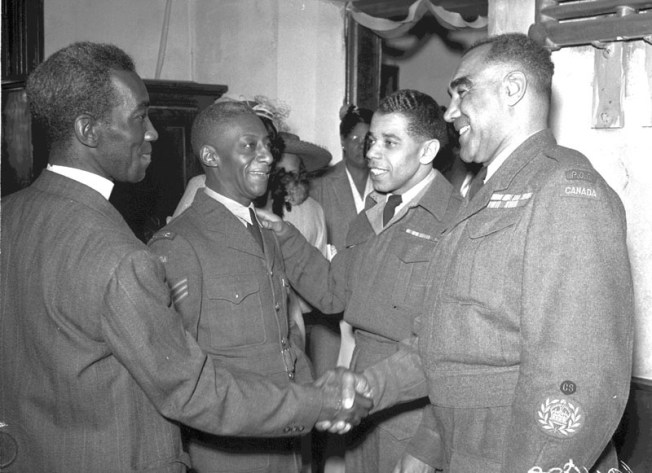
Photo credit: Canadian World War II veterans, May 31, 1946, Photographer: John Boyd, City of Toronto Archives
American Revolution 1775-1783
Canada developed a reputation as a safe haven for Blacks during the American Revolution. The British promised land, freedom and rights in exchange for services rendered and British Commander-in-Chief Sir Guy Carleton guaranteed that all slaves who formally requested British protection would be freed. Some of the Black Loyalists to reach Nova Scotia belonged to the “Company of Negroes”, who left Boston with British troops.
General Henry Clinton formed a corps of free Blacks, called the Black Pioneers to clear and construct the town of Shelburne and settle the Black Loyalists in Birchtown, Novia Scotia. An estimated 100,000 Blacks fled to the British side during the American Revolution. Ten per cent of the Loyalists coming into the Maritimes were Black.
Maroons of Jamaica 1796
On 22 July 1796, a group of 600 freedom-fighters landed at Halifax. These immigrants, called Maroons, came from the Jamaican community of escaped-slaves, who had guarded their freedom for more than a century and fought off countless attempts to re-enslave them.
War of 1812 (1812-1815)
The Cochrane Proclamation invited refugees to become British citizens through residence in British territory, including Canada. The British promise of freedom and land united many escaped slaves and free Blacks under the British flag. Fearing American conquest (and the return to slavery), many Blacks in Upper Canada served heroically in coloured and mixed race regiments.
In the summer of 1812, Black Loyalist Richard Pierpoint petitioned the government of Upper Canada to raise a company of Black troops to help protect the Niagara frontier. After some debate, the government agreed and a company of Blacks was formed under the command of a White officer, Captain Robert Runchey Sr.
In 1794, based on their military service in the war, 19 free Blacks in the Niagara area petitioned Governor Simcoe for a grant of land to establish an all-Black settlement. The petition was initially rejected, however, in 1815, Lieutenant-Governor Peregrine Maitland of Upper Canada began to offer Black veterans of the War of 1812 grants of land in the Township of Oro near Barrie, Ontario. In 1819 the government officially established the Oro Settlement for black veterans.
Mackenzie Rebellion 1837
In the early 19th century, few Upper Canada militia units included Blacks. When the Mackenzie Rebellion broke out, the government welcomed Black men into the provincial forces. On 11 December 1837, a militia order authorized Captains Thomas Runchey and James Sears to raise a “corps of Negroes”. Four days later, approximately 50 Blacks had joined the corps.
Royal Navy’s Seaman William Hall (b. 1827- d.1904)
In 1857, William Hall of Nova Scotia became the first Canadian Sailor and the first person of African descent to receive the Victoria Cross for bravery and distinguished service.
World War I (1914-1918 )
During the First World War, Black Canadians joined combat units, despite significant racial opposition. In 1916, as Canadian enlistment figures fell from 30,000 to 6,000 per month, while the year-end goal was a force of 500,000, Reverend C.W. Washington of Edmonton offered to raise an all-Black battalion. Military officials authorized the creation of a segregated unit called the Nova Scotia Number 2 Construction Battalion which served in France with the Canadian Forestry Corps.
Black Canadians at home became actively involved in the war effort. Black associations – on their own and in cooperation with their White counterparts – raised funds, worked in factories and volunteered in hospitals and as labourers.
World War II (1939-1945)
Initially, the Canadian military rejected Black volunteers but as the war continued, many Blacks were accepted into the Army and officer corps. While there was still some segregation in the Canadian forces until the end of the war, hundreds of Black Canadians served alongside Whites in Canada and Europe.
Blacks at home assumed the responsibilities of the men and women serving overseas, working alongside Whites, in jobs across the country. During World War II, hundreds of Black workers joined labour unions for the first time. The all-Black Brotherhood of Sleeping Car Porters was one of the greatest success stories of the war years.
Additional Sources:
Ontario Black History Society
BlackHistoryCanada.ca


 Evelyn Duberry - Glass Artist