Tales from the torch: Dec. 24th/07

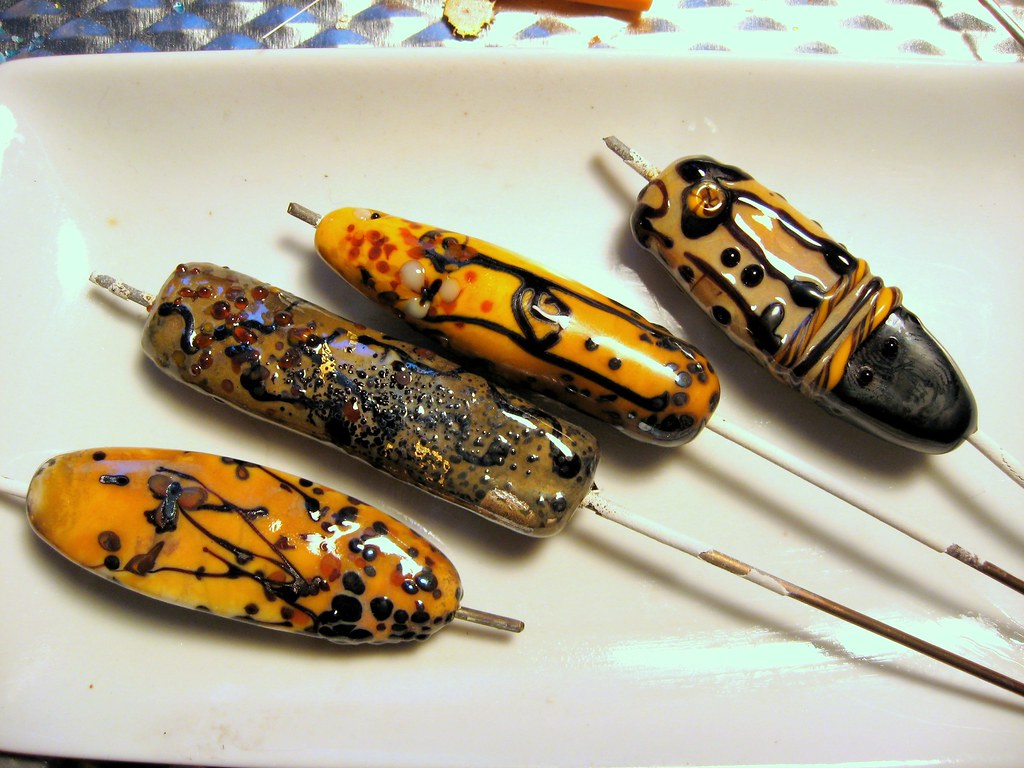
Another bunch of custom orders: requests were for oranges, reds, browns, golds… plus your first glimpse of anything “floral” from me.  They’re all around 2inches long or so.

 Red, orange, browns and golds

From left to right:

  • oval floral: (sold) this bead is my fave, I’ll have a hard time letting it go.  made with my new crunch bead press received for my b-day.  I’m realizing more and more I’m not really a “press” person – i find i only use them to start the bead and then refine the shape to suit my own tastes.  wish I’d realized that BEFORE i bought a pile of them…
  • rectangular tree: this bead was a total surprise – i layered the gold from the oval to the left over the orange from the teardrop to the right expecting a more muted orange but got this earthy brownish gold instead.  pretty cool… It has a bit of sparkle from the silver and gold leaf plus a bit of reduction around the bottom.  i left the frit partially raised so it feels great: all nice and nubbly
  • floral teardrop (sold): I like the shape and pattern on this one so much i think I’ll try it again with different colours.  Most noticeable here is how much my stringer (spaghetti sized threads of glass) control has improved – I can actually draw stems and leaves now!
  • flattened teardrop: this bead is a completely different and slightly retro direction. love it but the bottom half broke coming off the mandrel.  I’m thinking it’s either incompatibility between the glasses or else i didn’t keep it warm enough while making it.  I’m going to remake it to see which…

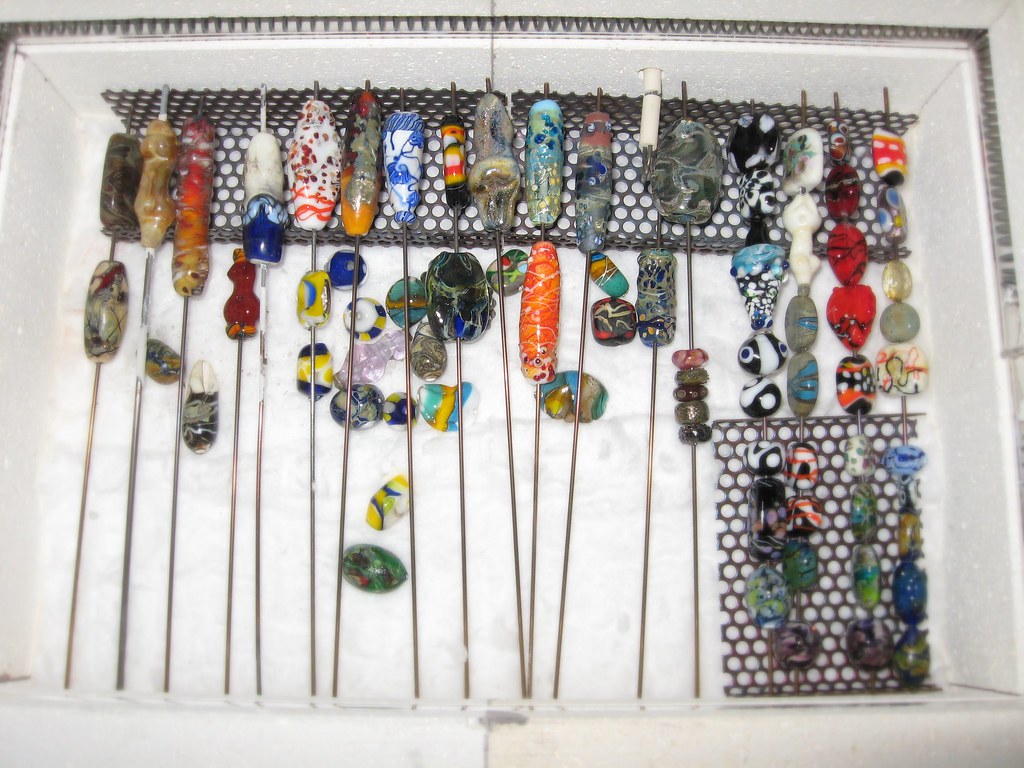
Nothing like a lovely warm soak…

beads in the kiln 

 …for several hours near 960F to keep my beadies happy and healthy.  Here’s a pic just after the completion of their cooling cycle in the kiln…

Today’s picture is also a hint regarding the second topic to be covered in Glass Class 101 (next session coming later this week).

Two pendants also off to a good home

I recently donated these two pendants to the charity silent auction at my office.  I’m happy to say both went to the same home.  Both pendants were wired on sterling silver and came with 18″ sterling silver snake chains.

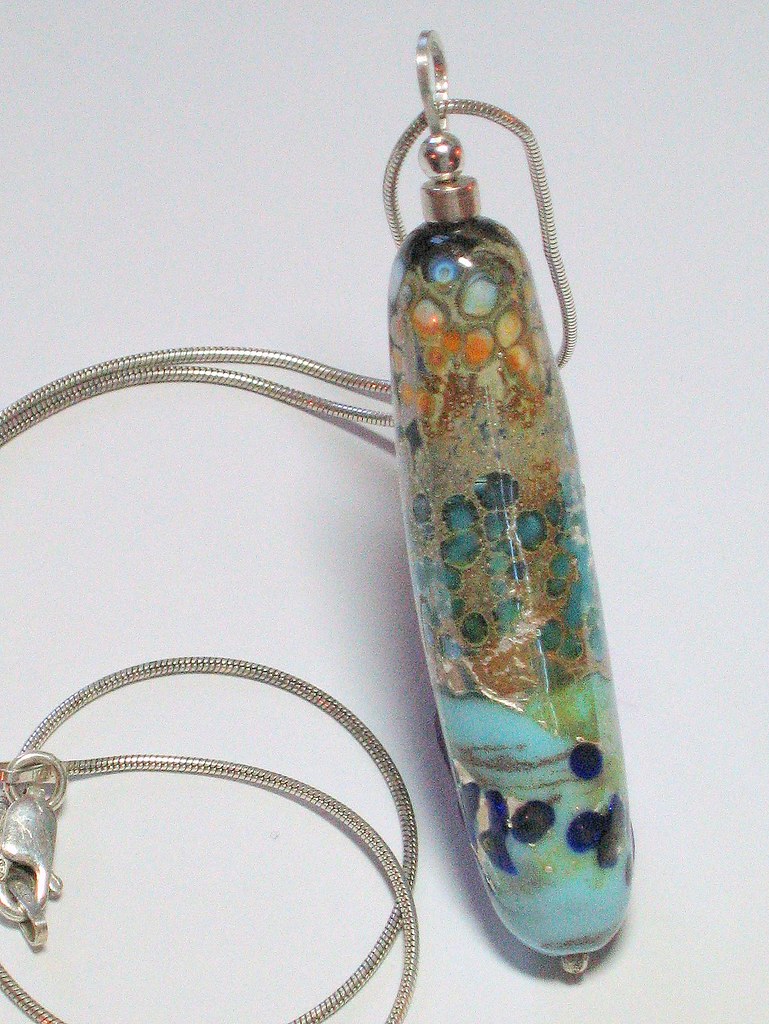
Spring Rain Pendant: Approx. 2.25″

The pendant is made of opaque and transparent light blue glass, wrapped in pure silver, then lightly sprinkled with several shades of frit (tiny glass chips).  The opaque blue base is slightly reduced to bring out the streaks of red copper within the glass.
Spring Rain 

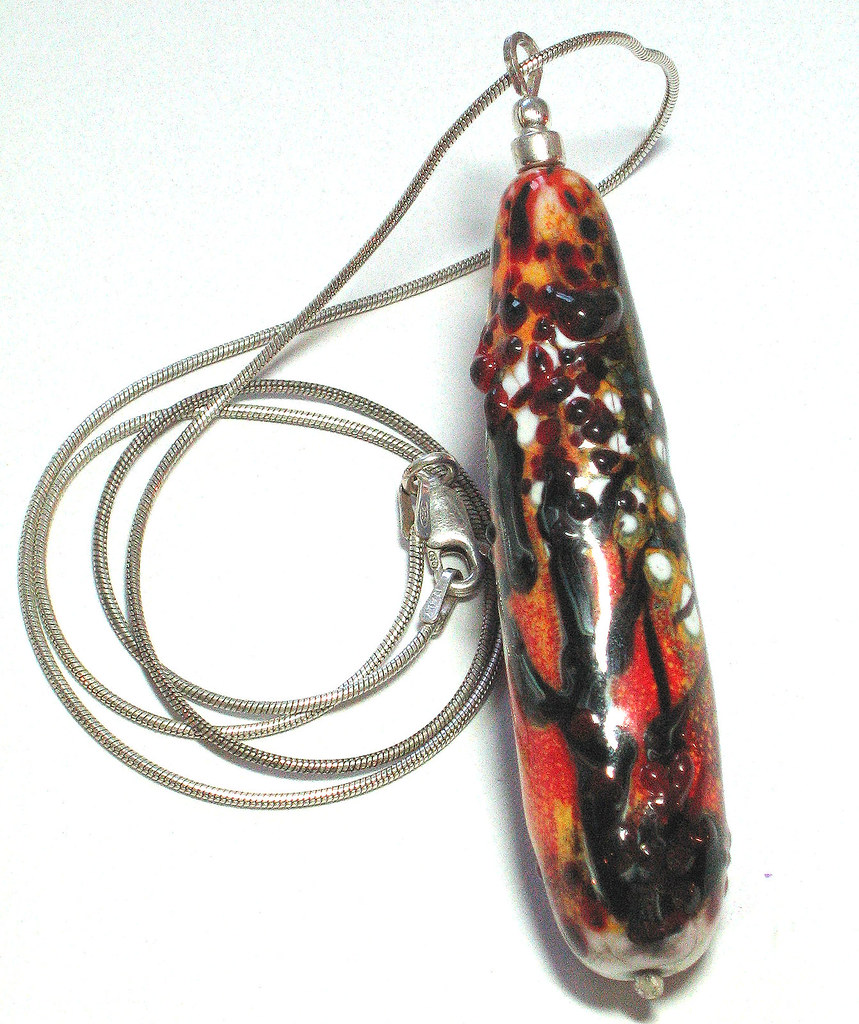
Autumn Leaves Pendant: Approx. 2.5″

The pendant is made of a white base of glass sprinkled with several shades of powdered enamel and frit.  The tree trunk is made from a tri-colour latticino (twisted glass cane).
Autumn Leaves

Grrrrrr…another unsuccessful picture-taking weekend.

Last night i bought another camera. 

Yes, again.  I think i’ve taken more than 200 bead pictures over the past couple weeks but barely 10 are usable.  The rest are all blurry or grainy when cropped, etc., etc… Thank goodness it’s all digital.  Can you imagine going through this process with film???  cha-ching!!  Oh well, at least I’ve finally figured out how to use a tripod and Photoshop.  

I returned the 5MP camera from a couple weeks ago and moved up to a 7MP model with a 5cm macro focus.  I’m hoping this new camera improves things… up to this point I’ve been a simple point and shoot photographer with little patience for fiddling with camera details. 

I have new respect for all those bead artists who consistently produce stunningingly clear photos of their glass art – who knew taking pics of itty-bitty beads would be so flippin’ hard??? 

If anyone has any tips to advance this process, they’d be much appreciated.  Cuz frankly, i’d rather spend my spare time making beads.

Glass Class 101: Bead Poop

Bead Poop 

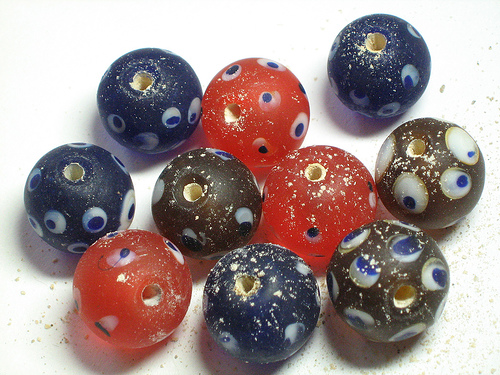
 Photo:  Mass market, lampwork beads –  lightly dry-reamed
BEAD POOP: Definition: (1) the crumbly, dirty remnants of bead release left in a lampwork bead’s hole once it has cooled and the mandrel removed; (2) the powdery crap you’ve learned to clean out of mass market lampwork beads so it doesn’t leave a mess all over your design; (3) the chunks of clay inside your bead holes that you eventually learn should be reamed under water so you don’t inhale all that dust.

Bead poop.  Yup, that’s what you’re seeing.  Now if you’ve ever bought mass market, lampwork beads like these, then you know exactly what bead poop is and how much of a pain it is to remove.  The beads above are from my old glass bead collection, purchased about 12 years ago (long before i ever knew anything about artisan lampwork) and at the time, very popular with my customers. 

Until I discovered artist-made lampwork, I accepted these glass beads as among the best I could find, bead poop as a normal part of bead buying and had an assortment of reamers to clean it out on my own.

So why is bead poop the topic of the day?
Because it’s a such simple thing yet one of the key differences between beads made by individual lampwork artists and factory-made, mass market lampwork beads.  Yes, both are made of glass.  Sure, both are made by hand.  And of course, both came off the torch with their holes filled to the gills with chunks of powdery bead poop.

Well, what’s the difference?
Lampwork artists clean out their bead poop.  Reaming bead holes is a sucky job (even for us) so we don’t make you do it.

And we won’t use just any bead release.  We worry about it.  We discuss it.  We even argue about it.  We hound bead release makers about improving their product and expect them to follow up.  We constantly experiment with multiple bead release formulas and various types of diamond reamers to figure out the clearest path to a completely poop-free bead.

You may not know this but lampwork nirvana is a transparent bead with a completely clear (not frosted) hole.  It means we’ve found that perfect combination of a bead release strong enough to securely hold the bead on the mandrel while we’re making it yet smooth enough to leave a completely clear hole.  And it means that one of the many reamers we’ve tried has just the right grade of fine diamond grit to clean out every last scrap of bead poop without also scratching up the inside of the glass.

But why such effort?
Because we care.  Every sale is an affirmation that one more person out there has become informed enough to appreciate what each of us has worked so hard to create.  Because we know you could have bought any of the gazillions of inexpensive, mass market glass beads out there but instead you bought ours.

Each and every purchase makes it all worth it: the hundreds (or thousands) spent setting up and stocking our studios; the many hours bent over the torch mastering each lampwork technique and exploring the possibilities of each rod of glass; not to mention the time spent ducking exploding glass, nursing burns and blisters, calculating ventilation, oxygen and fuel requirements, and researching the latest developments in hot glass, equipment or a new source of design inspiration.

Get it?
When you buy artisan lampwork, you’re not just buying a poop-free bead.  What you have in your hand is the accumulated effort of everything that one lampwork artist has struggled to achieve since they first sat behind a torch.

And that my dear readers, is the significance of bead poop.