Goddess beads off to their new homes

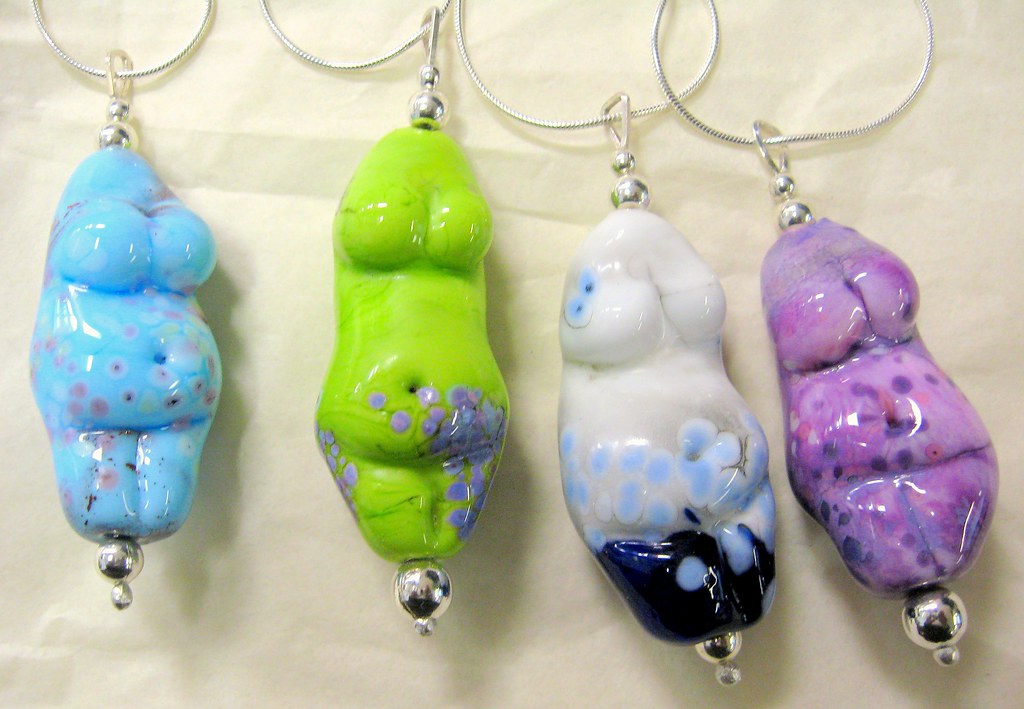
 All on sterling silver wire with a sterling snake chain.  Each bead averages approx. 1.5-2.5″ in length:

View from the front:

Goddesses front view

Spring Garden Goddess was created from a base of turquoise opaque glass. She was then lightly reduced to bring out the copper trails and sprinkled with a blend of pastel pink, yellow and white frit (tiny glass chips). She seems to have just returned from lying in a field of wildflowers.

Lime Fizz Goddess was created from a base of juicy lime green opaque glass. She was then lightly sprinkled with tiny turquoise flowers and a deep purple frit. The tiny bits of purple and blue create the effect of dancing in flower gardens.

Ocean Mist Goddess was created from a base of white opaque glass. Her thighs were encased in deep blue, before being lightly sprinkled with periwinkle frit. The periwinkle reacts with the white to create a soft, smoky mist over her torso.

Purplicious Goddess was created from a base of opaque glass. She was then rolled in a deep purple glass powder before being sprinkled with a frit blend of pink, purple and white. The powder and frits intermingle to give her a soft, dreamy effect.

View from the back: goddess beads rear view

Testing the new camera’s macro

The picture files are HUGE but so far i’m impressed with the detail in close up shots.   I’ll retake my bead pics this weekend and see how things go… I may finally be able to upload a mini gallery!

 My kitten Busta:

my kitten Busta 

The top of a pack of gum:

macro shot of a pack of gum

Tales from the torch: Nov. 21st-22nd/07

Results from my last few torch sessions: 

The four goddesses are sold (custom order).

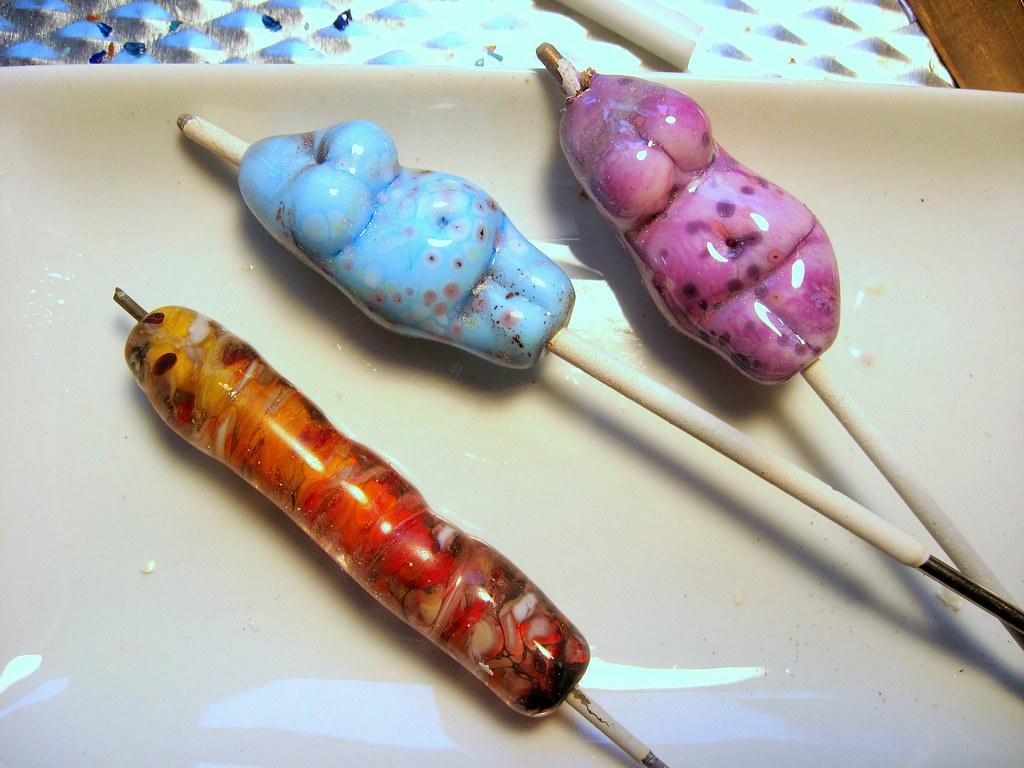
two goddess beads and a tube focal 

From left to right:

  • still playing with a warm palette – this focal combines enamels, frit and clear.  i’d originally planned to completely melt the clear encasing smooth and then decided to leave it lumpy.  The bumps feels great.
  • turquoise goddess with several shades of pastel frit.  i reduced her a little to bring out the earthy copper trails.  i think i’ve finally got the hang of reduction – at least with blue glass.  at one point i had her completely red and then was able to add and remove the red copper on her surface by waving her in and out of different parts of the flame. very cool.
  • i love purple – it’s my favourite colour but it’s one of the hardest to get in glass – the rod colours tend to either be greyish or do weird things in the flame.  This goddess is rolled in purple powder and then three shades of frit.

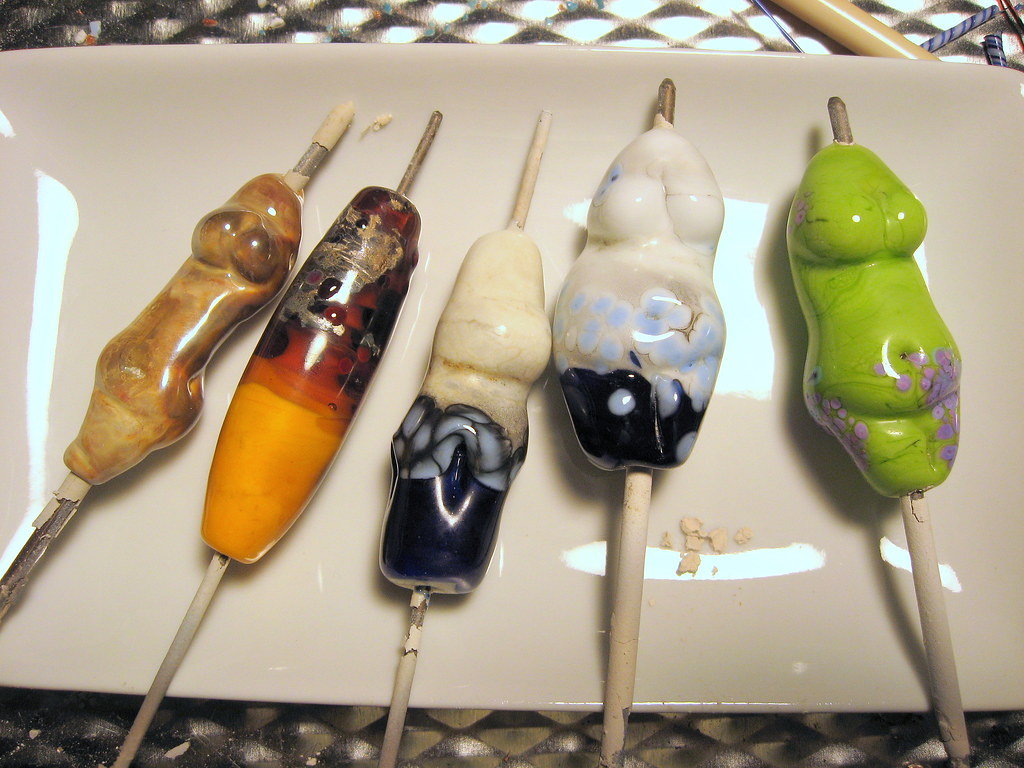
 last few torch sessions

From left to right:

  • another experiment with dark raku – this time i heated and cooled it a lot so the colour development progressed further – moved past the olive to more gold and hints of purple. will have to play more…
  • trying to find a way to get orange, reds and silver to play nicely together.  not quite there yet.  i’m happy with the shape though.
  • started a goddess but didn’t like the strong reaction between the light blue frit and the ivory – plus i ran out of fuel…lol.
  • tried again with a white base instead.  the softer reaction between the white and the light blue frit is much better
  • love this one!  bright green and purple frit – aren’t they awesome together??!!!

Grrrrrr…another unsuccessful picture-taking weekend.

Last night i bought another camera. 

Yes, again.  I think i’ve taken more than 200 bead pictures over the past couple weeks but barely 10 are usable.  The rest are all blurry or grainy when cropped, etc., etc… Thank goodness it’s all digital.  Can you imagine going through this process with film???  cha-ching!!  Oh well, at least I’ve finally figured out how to use a tripod and Photoshop.  

I returned the 5MP camera from a couple weeks ago and moved up to a 7MP model with a 5cm macro focus.  I’m hoping this new camera improves things… up to this point I’ve been a simple point and shoot photographer with little patience for fiddling with camera details. 

I have new respect for all those bead artists who consistently produce stunningingly clear photos of their glass art – who knew taking pics of itty-bitty beads would be so flippin’ hard??? 

If anyone has any tips to advance this process, they’d be much appreciated.  Cuz frankly, i’d rather spend my spare time making beads.

Glass Class 101: Bead Poop

Bead Poop 

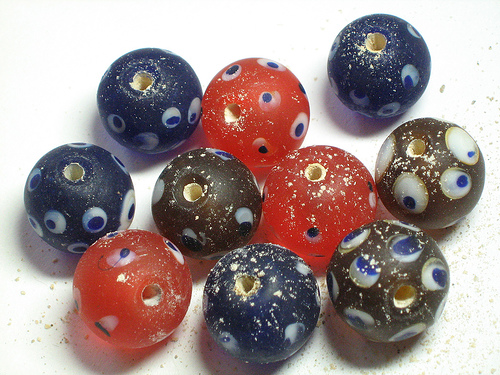
 Photo:  Mass market, lampwork beads –  lightly dry-reamed
BEAD POOP: Definition: (1) the crumbly, dirty remnants of bead release left in a lampwork bead’s hole once it has cooled and the mandrel removed; (2) the powdery crap you’ve learned to clean out of mass market lampwork beads so it doesn’t leave a mess all over your design; (3) the chunks of clay inside your bead holes that you eventually learn should be reamed under water so you don’t inhale all that dust.

Bead poop.  Yup, that’s what you’re seeing.  Now if you’ve ever bought mass market, lampwork beads like these, then you know exactly what bead poop is and how much of a pain it is to remove.  The beads above are from my old glass bead collection, purchased about 12 years ago (long before i ever knew anything about artisan lampwork) and at the time, very popular with my customers. 

Until I discovered artist-made lampwork, I accepted these glass beads as among the best I could find, bead poop as a normal part of bead buying and had an assortment of reamers to clean it out on my own.

So why is bead poop the topic of the day?
Because it’s a such simple thing yet one of the key differences between beads made by individual lampwork artists and factory-made, mass market lampwork beads.  Yes, both are made of glass.  Sure, both are made by hand.  And of course, both came off the torch with their holes filled to the gills with chunks of powdery bead poop.

Well, what’s the difference?
Lampwork artists clean out their bead poop.  Reaming bead holes is a sucky job (even for us) so we don’t make you do it.

And we won’t use just any bead release.  We worry about it.  We discuss it.  We even argue about it.  We hound bead release makers about improving their product and expect them to follow up.  We constantly experiment with multiple bead release formulas and various types of diamond reamers to figure out the clearest path to a completely poop-free bead.

You may not know this but lampwork nirvana is a transparent bead with a completely clear (not frosted) hole.  It means we’ve found that perfect combination of a bead release strong enough to securely hold the bead on the mandrel while we’re making it yet smooth enough to leave a completely clear hole.  And it means that one of the many reamers we’ve tried has just the right grade of fine diamond grit to clean out every last scrap of bead poop without also scratching up the inside of the glass.

But why such effort?
Because we care.  Every sale is an affirmation that one more person out there has become informed enough to appreciate what each of us has worked so hard to create.  Because we know you could have bought any of the gazillions of inexpensive, mass market glass beads out there but instead you bought ours.

Each and every purchase makes it all worth it: the hundreds (or thousands) spent setting up and stocking our studios; the many hours bent over the torch mastering each lampwork technique and exploring the possibilities of each rod of glass; not to mention the time spent ducking exploding glass, nursing burns and blisters, calculating ventilation, oxygen and fuel requirements, and researching the latest developments in hot glass, equipment or a new source of design inspiration.

Get it?
When you buy artisan lampwork, you’re not just buying a poop-free bead.  What you have in your hand is the accumulated effort of everything that one lampwork artist has struggled to achieve since they first sat behind a torch.

And that my dear readers, is the significance of bead poop.